Designer and developer
The Build System
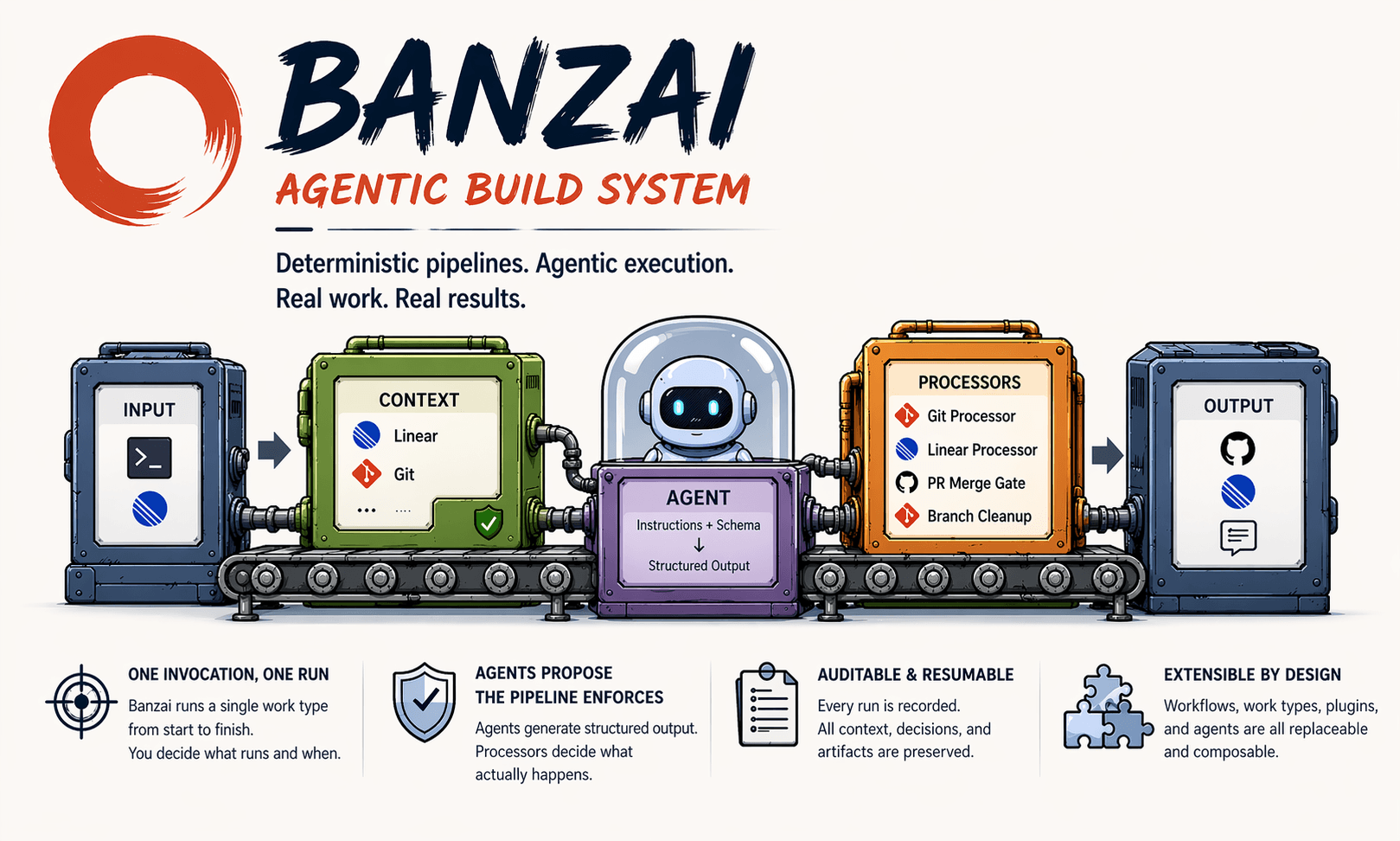
It started with simple experiments: saving prompts, writing process notes, tracking tasks in Linear, and trying to understand what made AI work better or worse. That turned into a workflow model with defined skills, issue states, worktrees, handoff points, and review gates.
Then I used the system to build itself, which was useful for exactly the wrong reason. It exposed the weakness in the architecture. Too much depended on the agent behaving well, and not enough of the structure around the agent was controlled.
Banzai is the rebuild. It's a pipeline framework for AI-assisted development.
Generators assemble the right context for the task. Pre-processors prepare the workspace and set the state. The agent performs the work. Processors handle the side effects afterward: updates, documentation, status changes, validation notes, or whatever else the workflow requires.
The important part is the boundary. The agent is the variable piece. The surrounding system is designed to be repeatable.
Banzai can work with more than one AI backend, including Claude Code and Codex. It uses Linear as the operating record, Git as the source of truth, and scoped worktrees so each task has a clean place to run.
The goal is simple: make AI useful without pretending it's trustworthy by default.